This post is part 3 of 3 in a short series about extraction and film.
- Part 1: Scenes of extraction
- Part 2: Can the extractive image break free?
I’m returning to Brian Jacobson’s book, The Cinema of Extractions, because I struggled with its ending, which presents Araya (Margot Benacerraf, 1959) alongside Scenes of Extraction (Sanaz Sohrabi, 2023) as examples of potential “counter-cinemas of extraction” which refuse “extractive world-making” (p. 145). Araya, an austere and precise account of life in an impoverished coastal village in Venezuela, is an extraordinary film. Its restoration – against all odds, overcoming institutional collapse and tropical weather – is a wonder. It’s a film that deserves its place among the great, and that should be watched and discussed widely. But I don’t agree that its form challenges extractive ways of seeing.
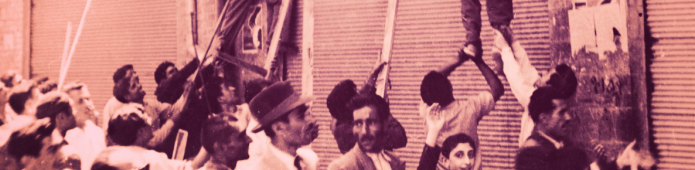
At Alchemy Film Festival, the closing screening of Araya was preceded by a live event that connected this story of salt with the larger question of extractivism, which in Venezuela has mainly meant oil. The 1981 satirical short Mayami Nuestro (Carlos Oteyza) captures the boom-times, where petrodollars flowed through Venezuelan consumers and towards the US; one way or another, the wealth from extraction goes elsewhere. But when the flow is interrupted (for instance through political upheaval), it’s still the local population that suffers more. In Latin America we have learned that the one thing that’s worse than being exploited, is to not be. If needs must, we go to the metropolis to seek our chance to be exploited there directly. While the films were screened, artist Esperanza Mayobre performed her 2005 work Immigration Services, which turns the migrant’s hopes into a prayer, where getting a green card is a kind of miracle. In the two decades since this piece was first performed, over seven million Venezuelans left the country, many of them walking the horribly dangerous Darien gap route, hoping to present themselves at the US border. Those who succeeded and those left behind may now be waiting to see what the US does after their removal of Maduro and the start of negotiations with oil companies. Extractivism creates and requires dependency, to name-drop another Latin American idea.
It was in this context then that we watched a selection of ‘offcuts’ from Araya, introduced by their restorer Andrés Prypchan. These silent fragments, retaining the crisp cinematography and formal composition characteristic of the film, are doubly powerful by virtue of not having the narration and by being removed from the circular structure of the whole. In Araya, much emphasis is placed on repetition. The backbreaking labour of dredging up and drying out the salt is repetitive, and it dictates the rhythm of each day, identical to the next. Other forms of labour, from fishing to pottery, are also arranged around this in their own loops, all supposedly part of a “closed economy”. Except that this is not a closed circuit: at the end, a ship comes and is loaded with salt, and some money is exchanged by middlemen. We have followed the salt in rigorous detail from the sea waves to here, but no further: who is profitting from the salt miner’s exhaustion? The circular form, for me, naturalises human misery, making it a consequence of scarcity rather than exploitation; the form of the film thus disguises the historical form. People toil to take salt from the sea: this salt goes somewhere, along with the profit it generates, but this vector goes almost unseen.
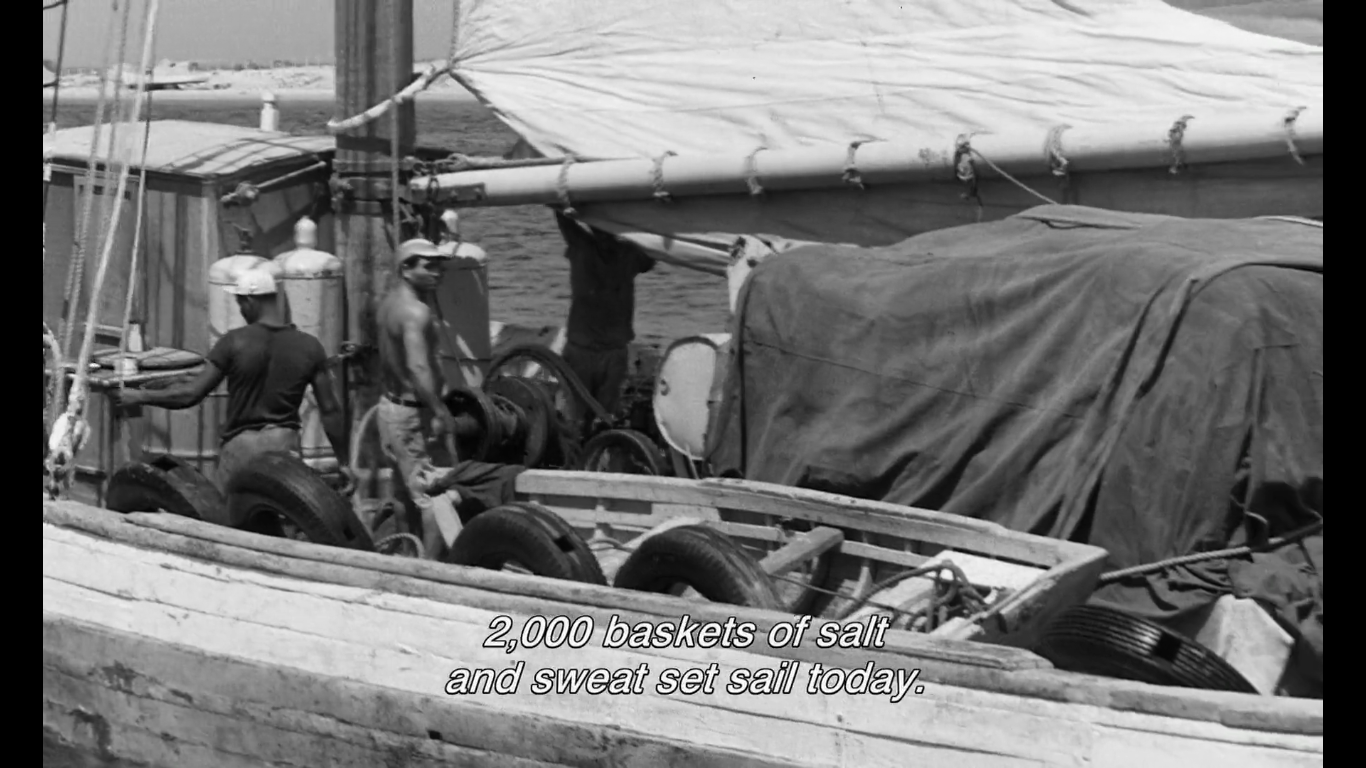
The narration’s humanist framing serves to further depoliticise its analysis, as it undermines the salient specificity of the images and of the people. Their voices are mostly present as collective hubbub or elegiac singing, while their experience is interpreted by the author, the French poet Pierre Seghers. I admit I have not read up on the film’s production history, which might reveal more about the creative choices and material factors that shaped the film. Benacerraf’s archives suggest that she was motivated in part by the imminence of change through a state modernisation project. Towards the end, when mechanical diggers arrive in Araya, the voiceover offers a melancholic presage of the possibility of modernisation. The machinery shots have a noticeably different photographic quality with much more grain and less precise focus, as if it had been shot on smaller gauge or less sensitive stock. This accident of shooting (Prypchan confirmed that this was shot at a later date by a different camera operator), and the clashing musical scores, intensify the contrast between the prosaic mode of the industrial film and the poetic gestures of the art film. Still, I wondered who could not be rooting for mechanisation after the wretchedness of manual labour we had just been asked to witness. I wondered what the salt miners would have said, had they been asked.
The same question could have been posed to the people in Morichales (Chris Gude, 2024), a film that could be a contemporary Araya, also formally uncompromising and driven by a ponderous narration. It was also shot in Venezuela, although far inland, where the ancient currents of the Orinoco river have dissolved specks of gold into the jungle soil. To get at this gold, men hire diesel pumps and diggers to liquify the soil and subject it to various vexations, leaving behind orange wastelands that can be seen from space. As an essay, the film narration doesn’t say anything that isn’t known. It considers the mismatch between price and value, the lack of value of the gold miner’s toil, the even greater lack of value of those who buy and trade the metal, the subsumption of the real value of life beneath the price of gold. It is almost inconceivable that people live like this, waist deep in mercury-laced mud, and indeed that they choose to live like this above the alternatives available to them, however meagre. They’re not invited to tell us why. The narration instead makes the miner into an archetype of compulsion, a sinner whose only hope of redemption is finding that promised nugget. Even though the film is close, very close to their sunburnt backs and their seeking hands, it stands back in judgement.
There are elements of a more systemic analysis here, with this moral judgement falling also on the global networks that draw on this miserable labour. The uselessness of their suffering is even more unbearable when you remember that most of that gold will sit in a vault doing nothing. But – like the merchant boat in Araya – only the edges of these networks are visible from here, and so we see extraction (“the act itself”) rather than extractivism (“the larger system by which natural resources are taken from one place and moved to another”). A counter-cinema, an anti-extractivist cinema perhaps, would need to be both alive to the webs of relations and committed to the specificity of each site and form of extraction. And this cannot be done without the voices of those whose bodies are spent, broken and poisoned in the process.