
Frame from a nitrate film showing damage to the emulsion. The image is of someone's hands gutting a fish.

Araya (1959) and Morichales (2024)

This post is part 3 of 3 in a short series about extraction and film.

I’m returning to Brian Jacobson’s book, The Cinema of Extractions, because I struggled with its ending, which presents Araya (Margot Benacerraf, 1959) alongside Scenes of Extraction (Sanaz Sohrabi, 2023) as examples of potential “counter-cinemas of extraction” which refuse “extractive world-making” (p. 145). Araya, an austere and precise account of life in an impoverished coastal village in Venezuela, is an extraordinary film. Its restoration – against all odds, overcoming institutional collapse and tropical weather – is a wonder. It’s a film that deserves its place among the great, and that should be watched and discussed widely. But I don’t agree that its form challenges extractive ways of seeing.

At Alchemy Film Festival, the closing screening of Araya was preceded by a live event that connected this story of salt with the larger question of extractivism, which in Venezuela has mainly meant oil. The 1981 satirical short Mayami Nuestro (Carlos Oteyza) captures the boom-times, where petrodollars flowed through Venezuelan consumers and towards the US; one way or another, the wealth from extraction goes elsewhere. But when the flow is interrupted (for instance through political upheaval), it’s still the local population that suffers more. In Latin America we have learned that the one thing that’s worse than being exploited, is to not be. If needs must, we go to the metropolis to seek our chance to be exploited there directly. While the films were screened, artist Esperanza Mayobre performed her 2005 work Immigration Services, which turns the migrant’s hopes into a prayer, where getting a green card is a kind of miracle. In the two decades since this piece was first performed, over seven million Venezuelans left the country, many of them walking the horribly dangerous Darien gap route, hoping to present themselves at the US border. Those who succeeded and those left behind may now be waiting to see what the US does after their removal of Maduro and the start of negotiations with oil companies. Extractivism creates and requires dependency, to name-drop another Latin American idea.

It was in this context then that we watched a selection of ‘offcuts’ from Araya, introduced by their restorer Andrés Prypchan. These silent fragments, retaining the crisp cinematography and formal composition characteristic of the film, are doubly powerful by virtue of not having the narration and by being removed from the circular structure of the whole. In Araya, much emphasis is placed on repetition. The backbreaking labour of dredging up and drying out the salt is repetitive, and it dictates the rhythm of each day, identical to the next. Other forms of labour, from fishing to pottery, are also arranged around this in their own loops, all supposedly part of a “closed economy”. Except that this is not a closed circuit: at the end, a ship comes and is loaded with salt, and some money is exchanged by middlemen. We have followed the salt in rigorous detail from the sea waves to here, but no further: who is profitting from the salt miner’s exhaustion? The circular form, for me, naturalises human misery, making it a consequence of scarcity rather than exploitation; the form of the film thus disguises the historical form. People toil to take salt from the sea: this salt goes somewhere, along with the profit it generates, but this vector goes almost unseen.
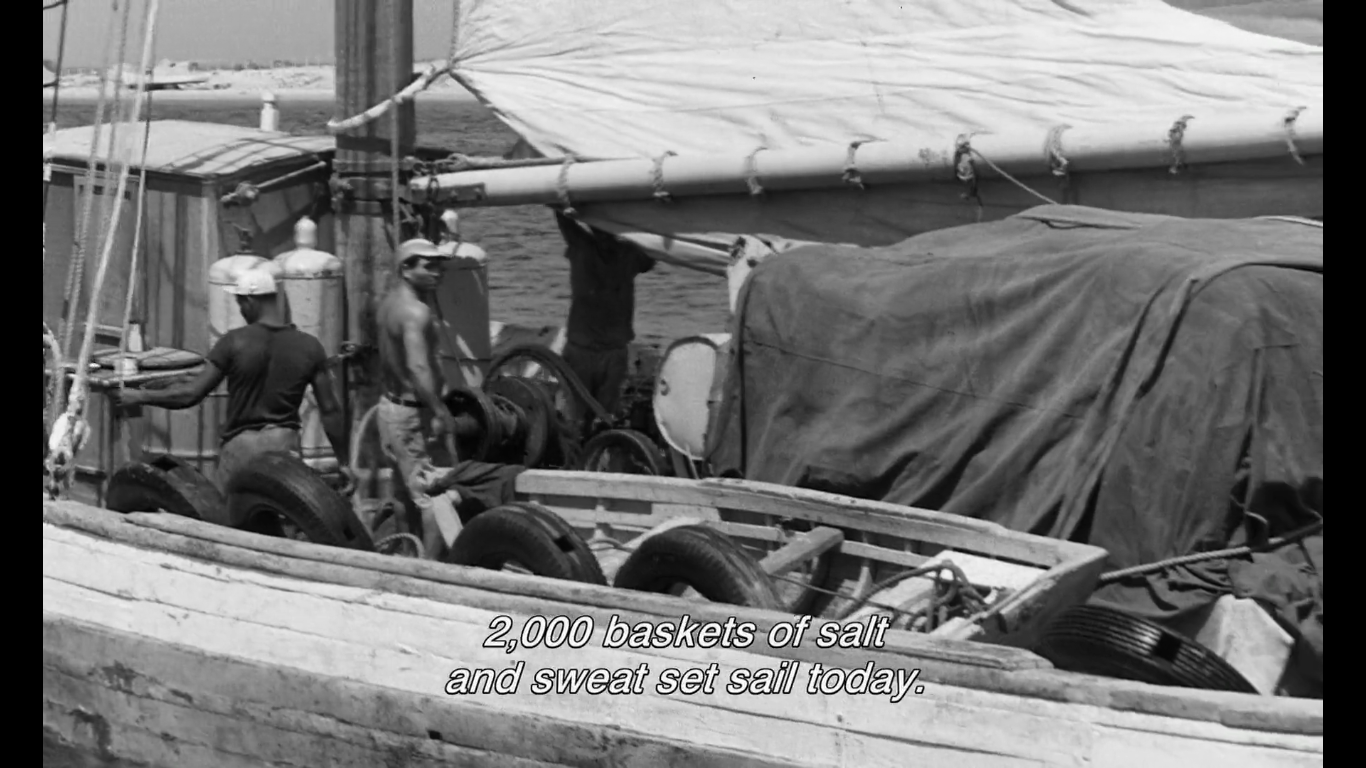
Still from Araya (1959). Black and white image of a sailing boat with two men standing in it. The subtitle says "2000 baskets of salt and sweat set sail today"
Still from Araya (1959), from the Internet Archive

The narration’s humanist framing serves to further depoliticise its analysis, as it undermines the salient specificity of the images and of the people. Their voices are mostly present as collective hubbub or elegiac singing, while their experience is interpreted by the author, the French poet Pierre Seghers. I admit I have not read up on the film’s production history, which might reveal more about the creative choices and material factors that shaped the film. Benacerraf’s archives suggest that she was motivated in part by the imminence of change through a state modernisation project. Towards the end, when mechanical diggers arrive in Araya, the voiceover offers a melancholic presage of the possibility of modernisation. The machinery shots have a noticeably different photographic quality with much more grain and less precise focus, as if it had been shot on smaller gauge or less sensitive stock. This accident of shooting (Prypchan confirmed that this was shot at a later date by a different camera operator), and the clashing musical scores, intensify the contrast between the prosaic mode of the industrial film and the poetic gestures of the art film. Still, I wondered who could not be rooting for mechanisation after the wretchedness of manual labour we had just been asked to witness. I wondered what the salt miners would have said, had they been asked.

The same question could have been posed to the people in Morichales (Chris Gude, 2024), a film that could be a contemporary Araya, also formally uncompromising and driven by a ponderous narration. It was also shot in Venezuela, although far inland, where the ancient currents of the Orinoco river have dissolved specks of gold into the jungle soil. To get at this gold, men hire diesel pumps and diggers to liquify the soil and subject it to various vexations, leaving behind orange wastelands that can be seen from space. As an essay, the film narration doesn’t say anything that isn’t known. It considers the mismatch between price and value, the lack of value of the gold miner’s toil, the even greater lack of value of those who buy and trade the metal, the subsumption of the real value of life beneath the price of gold. It is almost inconceivable that people live like this, waist deep in mercury-laced mud, and indeed that they choose to live like this above the alternatives available to them, however meagre. They’re not invited to tell us why. The narration instead makes the miner into an archetype of compulsion, a sinner whose only hope of redemption is finding that promised nugget. Even though the film is close, very close to their sunburnt backs and their seeking hands, it stands back in judgement.

There are elements of a more systemic analysis here, with this moral judgement falling also on the global networks that draw on this miserable labour. The uselessness of their suffering is even more unbearable when you remember that most of that gold will sit in a vault doing nothing. But – like the merchant boat in Araya – only the edges of these networks are visible from here, and so we see extraction (“the act itself”) rather than extractivism (“the larger system by which natural resources are taken from one place and moved to another”). A counter-cinema, an anti-extractivist cinema perhaps, would need to be both alive to the webs of relations and committed to the specificity of each site and form of extraction. And this cannot be done without the voices of those whose bodies are spent, broken and poisoned in the process.
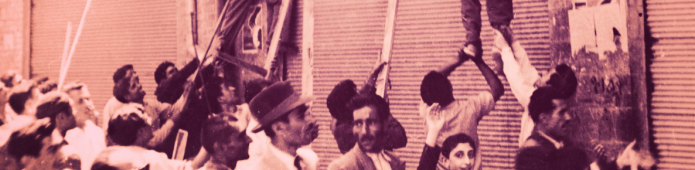
Fragment of a photograph showing a group of men taking down a shop sign as part of a street protest. Photo is from revolutionary period in Iran, from BP archives, included by Sanaz Sohrabi in her film.

Can the extractive image break free?

This post is part 2 of 3 in a short series about extraction and film. Part 1 is here: Scenes of extraction

Cinema’s role in bringing about climate catastrophe is linked to its construction of resource imaginaries, as much as to the production of operational images. There are different levels to this relationship. Some of the research gathered in the foundational collection, Petrocinema (ed. Dahlquist and Vonderau, 2021), focuses on the oil film’s mission of legitimating extraction by making it appear necessary to the viewer’s wellbeing, and enmeshed with pleasure at every turn. The better known examples make this a global endeavour, telling variations of a well-worn story about oil and progress whether in Iran, Nigeria, or Scotland. Once you’ve seen a few of the hundreds of films in the BP Video Library, it’s not hard to predict what others will be saying, and what they continue to say.

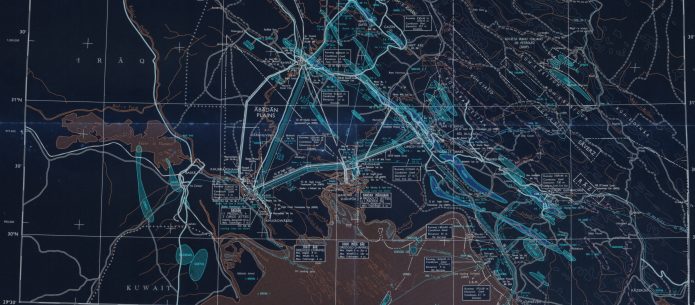
Sanaz Sohrabi’s 2023 film Scenes of Extraction, which I mentioned in the previous post, goes deeper, to a geological level: through seismography, the earth becomes a medium for sound, and sound can then be translated into images, to layer onto maps that guide the oil company towards the hidden treasure. This is the realm of the operative image, here a sound-vision assemblage that supports decision-making leading to investment and subsequent drilling. For the oil company to be there in the first place, though, political interventions are necessary. Mona Damluji’s infrastructural approach in Pipeline Cinema (2025) shows the extent to which corporate PR setups meld with, and sometimes replace, other cultural systems. It is not only about using images to tell a story, but about controlling the means through which stories are told, images made, and relationships woven. In an earlier film, One Image, Two Acts (2020), Sohrabi shows us reams of extremely sharp, beautifully shot photographs from the BP Archives. She argues that, in Iran, Britain (via the Anglo-Iranian Oil Company, now BP) ‘maintained an image-based monopoly through photography and film’, denying Iranians the means of representation. Where Scenes of Extraction exposed how land was abstracted into a legible medium, this one showed the abstraction of labour into disciplined bodies.

And yet the image exceeds this characterisation. The images are too sharp and detailed, so that each person in a crowd has a face and an expression. A foot is suspended mid-air as someone jumps over a length of pipe. Roland Barthes called this sort of poignant detail punctum, as any photography student has heard at some point:

“the element which rises from the scene, shoots out of it like an arrow, and pierces me” (Camera Lucida, p. 26)

The punctum is what unsettles the viewer, it is what breaks the ‘unary’ representation or story that a photograph may have intended, an intrusion of reality’s accidental nature (and of inexorable mortality) that gives the lie to the illusion of narrative control. Punctum is a kind of excess. In traditional film scholarship, excess is one of those cracks through which the ideological apparatus shows itself, undermining the stability of linear narrative. Punctum maybe is also a kind of attraction: Brian Jacobson’s conceptualisation of Cinema of Extractions refers back to Tom Gunning’s very productive framework, where early cinema’s exhibitionism is only partially subsumed within narrative voyeurism. With punctum, reality insists in showing itself against the story in which the photographic composition is trying to implicate or suture the viewer.

The insistent characterfulness of these images puts tension on Sohrabi’s argument. If the photos were part of the oil company’s efforts to compartmentalise, abstract and dehumanise workers, they succeed only partially, or only from certain angles. What they have also done is to leave a historical record which can be reclaimed: they have created a space for a political demand. Sohrabi poses a question about the right to the image, both on an individual level (for the people in these pictures) and on a collective one, regarding access to the means of cinematic representation.

The question of what a “cinema of reparations” would entail has been raised in various spaces. I turn to Alice Diop’s definition of her own practice, as a cinema that not only puts on screen people who have not been represented before, but does so by building “a whole device” for their appearing so that the image has power. If powerful images are those “that are there, that are addressed and that profoundly resist erasure”, the production of this power contains aesthetic choices, taking us back to the politics of form.

The last section of Sohrabi’s film gathers a few examples of what a different image of oil could be, a question that became generative for anti-colonial and revolutionary filmmaking. She closes her film with an sequence from Iranian New Wave feature The Runner (Amir Naderi, 1984). A group of children race across an arid landscape towards a block of ice which is melting rapidly in the heat of the burner flames of a pipeline. An interview with the director explains how the images were assembled in different places while representing his hometown, oil capital Abadan, which was being bombed during the Iraq-Iran war. This act of piecing together a remembered landscape through editing is then also an act of resistance, perhaps of restoration. This elemental set-piece of fire, ice, dirt, and human effort works through a finite number of carefully composed camera positions that bring those elements into intense relation. The editing iterates the shots to stretch time, to make you feel the unbearable heat, the hard ground, and the sough-after coolness of the ice. The spectacular attraction of fire becomes monstrous in repetition. It is indeed a powerful image and one that is hard to forget. Sohrabi sees it as somewhat spectral, a ghostly trace evoking the absent images of the workers.

Are the pictures missing, or held hostage? A cinema of reparations can be one of new images, repairing an absence, and it can also be one of liberated images that were made for oppression. The question of what to do with colonial archives needs to be led by those who were dispossessed by them.

To read part 3: Araya (1959) and Morichales (2024)

Negative image of section of a map showing the Abadan area in Iran with its oil infrastructure

Scenes of extraction

I’ve had a browser tab open since March 2024. It’s the page about Scenes of Extraction (2023) on filmmaker and researcher, Sanaz Sohrabi’s website. I kept it there as a reminder and pledge to write about the film after I watched it at Glasgow Short Film Festival, and it stayed there for two years. The scrawled notes taken in the dark of the CCA cinema become less legible over time, and the memory of the film becomes less detailed. Less detailed, but still insistent: its description of reflection seismography has become the way I enter those current philosophical discussions about elemental media, and its cut-up and reframed archives of the early Iranian oil industry are how I think about visuality and extraction, about operational images, about – as Sohrabi puts it – “the nexus of seeing and destroying”.

This is the last film discussed in Brian Jacobson’s 2025 book, The Cinema of Extractions, and in the book it is presented in dialogue with Araya (Margot Benacerraf, 1959), which was the closing film at Alchemy festival on May 2025. I had to finish this blog post, not just to organise my thoughts but also to show public gratitude to the people who put on festivals and make these encounters with film possible. I’m returning to it now after another curated encounter with Sohrabi’s work via the Centre for Energy Ethics’ online reading group. This time, we got to watch One Image, Two Acts (2024), while also reading a section of Mona Damluji’s new (open acccess!) book, Pipeline Cinema (2025), which places the moving image as part of the “cultural infrastructure” of the oil industry in Iraq and Iran. I’ll come back to Sohrabi’s films in the next post, and to Araya in a third one.

My blogging backlog has the benefit of showing how the theme of ‘extraction’ has continued to proliferate across scholarly collections, calls for papers, and festival programmes over the last few years. It is used to articulate new and old materialisms, to claim a political dimension in ecocriticism, to redirect attention to minoritised media, and to reappraise industrial and sponsored film. You can do lots of things with extraction. At the same time, the growing choice of ‘extraction’ rather than ‘extractivism’ gives me pause. They are different words, of course. As Thea Riofrancos defines them, “Extraction is the act itself, extractivism is the larger system by which natural resources are taken from one place and moved to another with minimal processing”. Much of the theory work that has enabled this analysis comes from Latin American lineages of ideas, what Riofrancos describes as the extractivismo discourse. As some of the concepts have been brought out of political economy and into humanities disciplines, this genealogy tends to recede from view.

An extractivismo framework applied to the analysis of film and other media can take many forms, and in the best examples, it also enacts self-reflection. It can help researchers and filmmakers to consider how their own actions can be extractive, even extractivist (when one considers the global disparities that shape how academic knowledge circulates, how it is valued, and who benefits from it, for instance). It thus needs to be reflexive on its own use of this framework. I’m not saying anything new by pointing out how concepts that emerge from political struggles can get defanged and appropriated by academics; it happens all the time. I also wouldn’t be interested in a purely self-regarding discipline that isn’t in dialogue with all others and with the world. We just have to try and be honest about it, which isn’t easy.

Regardless of what I might write in funding applications, I’m not convinced that analysing films is a meaningful way to bring about a better world or support the people putting their lives on the line for it, which doesn’t mean it’s not worth doing. In his book, which I reviewed for the HJFRT (apologies for the Taylor & Francis paywall, pre-print here), Jacobson makes the case for textual analysis, drawing on literary and art-history concepts. The emergent ‘eco-formalism’ is part of a very long discussion about the politics of form and the political potential of formal critique. In the next two posts I’ll muddle through my own encounters with films about extraction as I try to figure out what I think about this.

Next up: