This post is part 2 of 3 in a short series about extraction and film. Part 1 is here: Scenes of extraction
Cinema’s role in bringing about climate catastrophe is linked to its construction of resource imaginaries, as much as to the production of operational images. There are different levels to this relationship. Some of the research gathered in the foundational collection, Petrocinema (ed. Dahlquist and Vonderau, 2021), focuses on the oil film’s mission of legitimating extraction by making it appear necessary to the viewer’s wellbeing, and enmeshed with pleasure at every turn. The better known examples make this a global endeavour, telling variations of a well-worn story about oil and progress whether in Iran, Nigeria, or Scotland. Once you’ve seen a few of the hundreds of films in the BP Video Library, it’s not hard to predict what others will be saying, and what they continue to say.
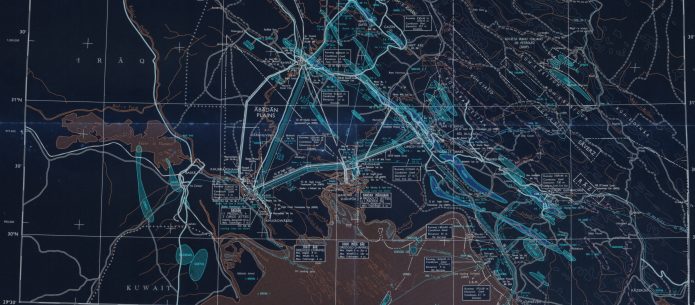
Sanaz Sohrabi’s 2023 film Scenes of Extraction, which I mentioned in the previous post, goes deeper, to a geological level: through seismography, the earth becomes a medium for sound, and sound can then be translated into images, to layer onto maps that guide the oil company towards the hidden treasure. This is the realm of the operative image, here a sound-vision assemblage that supports decision-making leading to investment and subsequent drilling. For the oil company to be there in the first place, though, political interventions are necessary. Mona Damluji’s infrastructural approach in Pipeline Cinema (2025) shows the extent to which corporate PR setups meld with, and sometimes replace, other cultural systems. It is not only about using images to tell a story, but about controlling the means through which stories are told, images made, and relationships woven. In an earlier film, One Image, Two Acts (2020), Sohrabi shows us reams of extremely sharp, beautifully shot photographs from the BP Archives. She argues that, in Iran, Britain (via the Anglo-Iranian Oil Company, now BP) ‘maintained an image-based monopoly through photography and film’, denying Iranians the means of representation. Where Scenes of Extraction exposed how land was abstracted into a legible medium, this one showed the abstraction of labour into disciplined bodies.
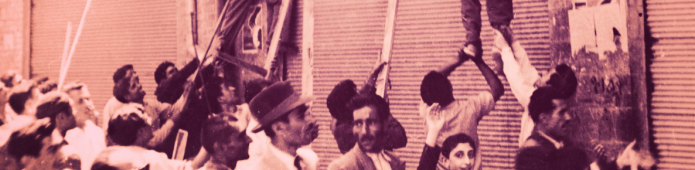
And yet the image exceeds this characterisation. The images are too sharp and detailed, so that each person in a crowd has a face and an expression. A foot is suspended mid-air as someone jumps over a length of pipe. Roland Barthes called this sort of poignant detail punctum, as any photography student has heard at some point:
“the element which rises from the scene, shoots out of it like an arrow, and pierces me” (Camera Lucida, p. 26)
The punctum is what unsettles the viewer, it is what breaks the ‘unary’ representation or story that a photograph may have intended, an intrusion of reality’s accidental nature (and of inexorable mortality) that gives the lie to the illusion of narrative control. Punctum is a kind of excess. In traditional film scholarship, excess is one of those cracks through which the ideological apparatus shows itself, undermining the stability of linear narrative. Punctum maybe is also a kind of attraction: Brian Jacobson’s conceptualisation of Cinema of Extractions refers back to Tom Gunning’s very productive framework, where early cinema’s exhibitionism is only partially subsumed within narrative voyeurism. With punctum, reality insists in showing itself against the story in which the photographic composition is trying to implicate or suture the viewer.
The insistent characterfulness of these images puts tension on Sohrabi’s argument. If the photos were part of the oil company’s efforts to compartmentalise, abstract and dehumanise workers, they succeed only partially, or only from certain angles. What they have also done is to leave a historical record which can be reclaimed: they have created a space for a political demand. Sohrabi poses a question about the right to the image, both on an individual level (for the people in these pictures) and on a collective one, regarding access to the means of cinematic representation.
The question of what a “cinema of reparations” would entail has been raised in various spaces. I turn to Alice Diop’s definition of her own practice, as a cinema that not only puts on screen people who have not been represented before, but does so by building “a whole device” for their appearing so that the image has power. If powerful images are those “that are there, that are addressed and that profoundly resist erasure”, the production of this power contains aesthetic choices, taking us back to the politics of form.
The last section of Sohrabi’s film gathers a few examples of what a different image of oil could be, a question that became generative for anti-colonial and revolutionary filmmaking. She closes her film with an sequence from Iranian New Wave feature The Runner (Amir Naderi, 1984). A group of children race across an arid landscape towards a block of ice which is melting rapidly in the heat of the burner flames of a pipeline. An interview with the director explains how the images were assembled in different places while representing his hometown, oil capital Abadan, which was being bombed during the Iraq-Iran war. This act of piecing together a remembered landscape through editing is then also an act of resistance, perhaps of restoration. This elemental set-piece of fire, ice, dirt, and human effort works through a finite number of carefully composed camera positions that bring those elements into intense relation. The editing iterates the shots to stretch time, to make you feel the unbearable heat, the hard ground, and the sough-after coolness of the ice. The spectacular attraction of fire becomes monstrous in repetition. It is indeed a powerful image and one that is hard to forget. Sohrabi sees it as somewhat spectral, a ghostly trace evoking the absent images of the workers.
Are the pictures missing, or held hostage? A cinema of reparations can be one of new images, repairing an absence, and it can also be one of liberated images that were made for oppression. The question of what to do with colonial archives needs to be led by those who were dispossessed by them.
To read part 3: Araya (1959) and Morichales (2024)