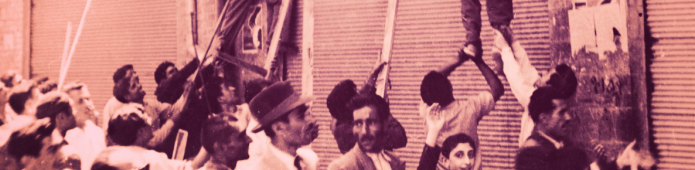
Fragment of a photograph showing a group of men taking down a shop sign as part of a street protest. Photo is from revolutionary period in Iran, from BP archives, included by Sanaz Sohrabi in her film.

Can the extractive image break free?

This post is part 2 of 3 in a short series about extraction and film. Part 1 is here: Scenes of extraction

Cinema’s role in bringing about climate catastrophe is linked to its construction of resource imaginaries, as much as to the production of operational images. There are different levels to this relationship. Some of the research gathered in the foundational collection, Petrocinema (ed. Dahlquist and Vonderau, 2021), focuses on the oil film’s mission of legitimating extraction by making it appear necessary to the viewer’s wellbeing, and enmeshed with pleasure at every turn. The better known examples make this a global endeavour, telling variations of a well-worn story about oil and progress whether in Iran, Nigeria, or Scotland. Once you’ve seen a few of the hundreds of films in the BP Video Library, it’s not hard to predict what others will be saying, and what they continue to say.

Sanaz Sohrabi’s 2023 film Scenes of Extraction, which I mentioned in the previous post, goes deeper, to a geological level: through seismography, the earth becomes a medium for sound, and sound can then be translated into images, to layer onto maps that guide the oil company towards the hidden treasure. This is the realm of the operative image, here a sound-vision assemblage that supports decision-making leading to investment and subsequent drilling. For the oil company to be there in the first place, though, political interventions are necessary. Mona Damluji’s infrastructural approach in Pipeline Cinema (2025) shows the extent to which corporate PR setups meld with, and sometimes replace, other cultural systems. It is not only about using images to tell a story, but about controlling the means through which stories are told, images made, and relationships woven. In an earlier film, One Image, Two Acts (2020), Sohrabi shows us reams of extremely sharp, beautifully shot photographs from the BP Archives. She argues that, in Iran, Britain (via the Anglo-Iranian Oil Company, now BP) ‘maintained an image-based monopoly through photography and film’, denying Iranians the means of representation. Where Scenes of Extraction exposed how land was abstracted into a legible medium, this one showed the abstraction of labour into disciplined bodies.

And yet the image exceeds this characterisation. The images are too sharp and detailed, so that each person in a crowd has a face and an expression. A foot is suspended mid-air as someone jumps over a length of pipe. Roland Barthes called this sort of poignant detail punctum, as any photography student has heard at some point:

“the element which rises from the scene, shoots out of it like an arrow, and pierces me” (Camera Lucida, p. 26)

The punctum is what unsettles the viewer, it is what breaks the ‘unary’ representation or story that a photograph may have intended, an intrusion of reality’s accidental nature (and of inexorable mortality) that gives the lie to the illusion of narrative control. Punctum is a kind of excess. In traditional film scholarship, excess is one of those cracks through which the ideological apparatus shows itself, undermining the stability of linear narrative. Punctum maybe is also a kind of attraction: Brian Jacobson’s conceptualisation of Cinema of Extractions refers back to Tom Gunning’s very productive framework, where early cinema’s exhibitionism is only partially subsumed within narrative voyeurism. With punctum, reality insists in showing itself against the story in which the photographic composition is trying to implicate or suture the viewer.

The insistent characterfulness of these images puts tension on Sohrabi’s argument. If the photos were part of the oil company’s efforts to compartmentalise, abstract and dehumanise workers, they succeed only partially, or only from certain angles. What they have also done is to leave a historical record which can be reclaimed: they have created a space for a political demand. Sohrabi poses a question about the right to the image, both on an individual level (for the people in these pictures) and on a collective one, regarding access to the means of cinematic representation.

The question of what a “cinema of reparations” would entail has been raised in various spaces. I turn to Alice Diop’s definition of her own practice, as a cinema that not only puts on screen people who have not been represented before, but does so by building “a whole device” for their appearing so that the image has power. If powerful images are those “that are there, that are addressed and that profoundly resist erasure”, the production of this power contains aesthetic choices, taking us back to the politics of form.

The last section of Sohrabi’s film gathers a few examples of what a different image of oil could be, a question that became generative for anti-colonial and revolutionary filmmaking. She closes her film with an sequence from Iranian New Wave feature The Runner (Amir Naderi, 1984). A group of children race across an arid landscape towards a block of ice which is melting rapidly in the heat of the burner flames of a pipeline. An interview with the director explains how the images were assembled in different places while representing his hometown, oil capital Abadan, which was being bombed during the Iraq-Iran war. This act of piecing together a remembered landscape through editing is then also an act of resistance, perhaps of restoration. This elemental set-piece of fire, ice, dirt, and human effort works through a finite number of carefully composed camera positions that bring those elements into intense relation. The editing iterates the shots to stretch time, to make you feel the unbearable heat, the hard ground, and the sough-after coolness of the ice. The spectacular attraction of fire becomes monstrous in repetition. It is indeed a powerful image and one that is hard to forget. Sohrabi sees it as somewhat spectral, a ghostly trace evoking the absent images of the workers.

Are the pictures missing, or held hostage? A cinema of reparations can be one of new images, repairing an absence, and it can also be one of liberated images that were made for oppression. The question of what to do with colonial archives needs to be led by those who were dispossessed by them.

To read part 3: Araya (1959) and Morichales (2024)
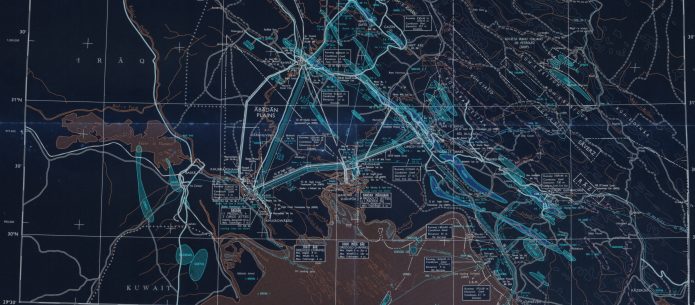
Negative image of section of a map showing the Abadan area in Iran with its oil infrastructure

Scenes of extraction

I’ve had a browser tab open since March 2024. It’s the page about Scenes of Extraction (2023) on filmmaker and researcher, Sanaz Sohrabi’s website. I kept it there as a reminder and pledge to write about the film after I watched it at Glasgow Short Film Festival, and it stayed there for two years. The scrawled notes taken in the dark of the CCA cinema become less legible over time, and the memory of the film becomes less detailed. Less detailed, but still insistent: its description of reflection seismography has become the way I enter those current philosophical discussions about elemental media, and its cut-up and reframed archives of the early Iranian oil industry are how I think about visuality and extraction, about operational images, about – as Sohrabi puts it – “the nexus of seeing and destroying”.

This is the last film discussed in Brian Jacobson’s 2025 book, The Cinema of Extractions, and in the book it is presented in dialogue with Araya (Margot Benacerraf, 1959), which was the closing film at Alchemy festival on May 2025. I had to finish this blog post, not just to organise my thoughts but also to show public gratitude to the people who put on festivals and make these encounters with film possible. I’m returning to it now after another curated encounter with Sohrabi’s work via the Centre for Energy Ethics’ online reading group. This time, we got to watch One Image, Two Acts (2024), while also reading a section of Mona Damluji’s new (open acccess!) book, Pipeline Cinema (2025), which places the moving image as part of the “cultural infrastructure” of the oil industry in Iraq and Iran. I’ll come back to Sohrabi’s films in the next post, and to Araya in a third one.

My blogging backlog has the benefit of showing how the theme of ‘extraction’ has continued to proliferate across scholarly collections, calls for papers, and festival programmes over the last few years. It is used to articulate new and old materialisms, to claim a political dimension in ecocriticism, to redirect attention to minoritised media, and to reappraise industrial and sponsored film. You can do lots of things with extraction. At the same time, the growing choice of ‘extraction’ rather than ‘extractivism’ gives me pause. They are different words, of course. As Thea Riofrancos defines them, “Extraction is the act itself, extractivism is the larger system by which natural resources are taken from one place and moved to another with minimal processing”. Much of the theory work that has enabled this analysis comes from Latin American lineages of ideas, what Riofrancos describes as the extractivismo discourse. As some of the concepts have been brought out of political economy and into humanities disciplines, this genealogy tends to recede from view.

An extractivismo framework applied to the analysis of film and other media can take many forms, and in the best examples, it also enacts self-reflection. It can help researchers and filmmakers to consider how their own actions can be extractive, even extractivist (when one considers the global disparities that shape how academic knowledge circulates, how it is valued, and who benefits from it, for instance). It thus needs to be reflexive on its own use of this framework. I’m not saying anything new by pointing out how concepts that emerge from political struggles can get defanged and appropriated by academics; it happens all the time. I also wouldn’t be interested in a purely self-regarding discipline that isn’t in dialogue with all others and with the world. We just have to try and be honest about it, which isn’t easy.

Regardless of what I might write in funding applications, I’m not convinced that analysing films is a meaningful way to bring about a better world or support the people putting their lives on the line for it, which doesn’t mean it’s not worth doing. In his book, which I reviewed for the HJFRT (apologies for the Taylor & Francis paywall, pre-print here), Jacobson makes the case for textual analysis, drawing on literary and art-history concepts. The emergent ‘eco-formalism’ is part of a very long discussion about the politics of form and the political potential of formal critique. In the next two posts I’ll muddle through my own encounters with films about extraction as I try to figure out what I think about this.

Next up:

Death and the online film festival

One of the first blog posts here was about cinema as ritual, in two senses: as a social practice and as a formal set of actions that may address an abstract or supernatural purpose. The pandemic has brought about a crisis of collective rituals, from the quotidian to the transcendental. This unravelling of common habits has mundane consequences, like losing track of the days of the week, but also profoundly painful ones. At tens of thousands of lonely hospital beds and funerals, the conventions that allow human societies to cope with death and grief are tenuously sustained by video-calls. It is both miraculous and crushing in its banality.

If the most sacred and necessary of rituals are being mediated by online streaming, it is no surprise that everything else, from pub quizzes to orchestras, is streaming somewhere. After a spate of cancellations, film festivals and academic conferences have also now returned as online programmes, and probably stand a better chance of survival than the cinema venues and universities that would have hosted them. For anyone lucky enough to have a computer, an internet connection and a safe home, and who isn’t being forced to risk their lives at work, this situation has generated a surfeit of ‘content’ far beyond the usual limitations of geography and timing. The expanded remote access includes participants that otherwise would have been excluded due to disability or location, and it excludes others who have divergent relationships to technology. I don’t want to enter into a discussion of whether streaming is good or bad, better or worse than cinemagoing or conference panels, as I have no interest in protecting those rituals. I don’t care if they survive; I care deeply about the people who depend on them for a livelihood, but that’s a different issue.

This is not a festival venue

This is not a festival venue

Online access is the consummation of mechanical reproducibility, and as Benjamin argued, the breakdown of uniqueness can demystify the reproduced object and wrench it out of the sphere of ritual. The tension between reproducibility (of the film) and uniqueness (of the event) is constitutive to the existence of film festivals, conceived as a way to ‘eventify’ film. This is being negotiated online in many different ways, as the sector fumbles towards new models that may enable some semblance of survival. Live streaming, time-limited access, and live Q&A sessions are some of the strategies that festivals are using to assert a sense of occasion, which is to say, a ritual time. The first online festival I attended this year was Alchemy, which had live screenings and a very pared down, straightforward interaction centered around brief introductions by programmers and a chat box after the film. As a taste of the new normal, and it had many advantages, such as an international audience and the ability to eat lunch during the screening without bothering others. But it didn’t have the treasure hunt of site-specific screenings around Hawick, the floor-to-ceiling screen in perfect darkness, or the gap between screenings to write notes in a sunlit window, go charity-shopping, or eavesdrop on earnest filmmakers at the café. It’s the ‘in-between bits’ that are missing, as Tara Judah wrote a few days ago. The gaps are backfilled with housework or email, and so the ritual contract is fragmented.

It becomes very difficult for festivals to offer a distinctive experience without their unique locations. In a recent piece, Erika Balsom considers how “presented online, moving-image artworks risk absorption into a ceaseless cascade of undifferentiated “content.””. From behind a laptop screen it all looks pretty much the same, despite the bewildering proliferation of platforms and logins. It is all also a bit more intentional, less random, like most things online which depend on being called up by the consumers, and are therefore less likely to surprise them. The waning of unintentional, unplanned sociability is harder to articulate as a loss in the pandemic, as governments entrench a worldview where the important relationships are those of wage work first, and normative family unit second. Online film viewing is – in my experience – similarly tending towards the productive or the familiar, more fully realised as labour because the stretches of time around it have been minimised. With no travelling to the cinema or waiting in the lobby, there is nowhere online where you can just sit and do nothing, let things unfold that don’t depend on your intervention and choice.

The fantasy of digital availability of everything presents itself as a fugue from mortality. You can’t miss anything – you can always watch it later (I am still genuinely upset about MUBI’s departure from its 30-days-only model, which at least allowed you to move on if you had missed a film). But of course, you don’t have infinite time. You don’t know if you can ever watch it later. Life is literally too short. The life of images can also be shorter than you think, links rotting all over the web, emulsions sliding, nitrate burning. At Alchemy, several films reflected on the failure of the archive to deliver the future promised by the past. In Salma Shamel’s short film, Those That Tremble as if They Were Mad, an inkjet printer sits in a backyard, printing certificates intended to reward contributors of oral testimonies of Egypt’s 2011 revolution. The bureaucratic attempts can’t help but extinguish the same radical fire they intend to record, and soon succumb to the reactionary collapse of the popular uprising. In another screening, Onyeka Igwe’s No Archive Can Restore You lingered over the rusted cans of the Nigerian Film Unit. The decay of analogue film has a well-established romance, perhaps because its time is just out of reach, within living memory, and hence its destruction is imagined as preventable. But as with any technology of memory, the loss of film is as indispensable as its survival to its history.

The Orphan Film Symposium is premised on this ephemerality. Orphan films survive by accident. They give the lie to the fantasy of total availability, representing as they do the tip of a lost iceberg. Meant to serve a time-limited purpose, the passage of these films into history has been crafted with today’s arguments, technologies, and archival optics. Often meant to be private, their public existence diffracts their modes of address and complicates their understanding. This is perhaps the logical setting in which to think about death, and this symposium offered a needed space to do that. It was also one of the best academic conferences / film festivals I have ever attended, and its expanded universe of blog posts and videos constitutes an incredible, generous, and timely resource. Against the relentless futurity of business as usual, the mood at this event felt more authentic. The incredibly skilled technical team greeted us from Mexico DF, wearing facemasks. Presenters joined in from around the world, lamenting a missed appointment at Amsterdam, and always finishing with ‘stay safe’. The combined themes of the symposium – water, climate and migration – reminded us that beneath the current emergency there is a catastrophe that hasn’t gone away with the decreased CO2 emissions of recent months. In other words, widespread death, closed borders, and a retrenchment into the private sphere are not going to stop the waters from rising.

There were two moments in the festival that confronted me with death more directly. At the end of the first day of screenings, as I watched from my sofa well past midnight, I was taken by surprise by a film where Eiren Caffall reflected on her life with the same chronic illness that will probably kill me one day. Safe and alone in my house, I could let my fear run through me until it exhausted itself, find a healing use for that metaphor of the sea within. In that moment I was glad not to have to make small talk with colleagues over canapes afterwards. Then on the third day, also late at night, Ja’Tovia Gary introduced her extraordinary essay film The Giverny Document. Watching this multilayered inquiry into Black experience and pain, on the day of George Floyd’s murder by a white policeman, amplified the rage that the images demand. The artist talked about the intricate, beautiful work of animation directly onto film as a somewhat therapeutic practice, which created a powerful tension with archive footage including evidence of police brutality recorded on phones. In conversation with archivist Terri Francis, they consider the fact that thinking about Black media is also thinking about the moving image as evidence. Over the days since then this question has been on my mind, as the harrowing images of George Floyd’s death, filmed by a black teenager, join this ‘counter-archive’ of atrocity and injustice.

But also in the archive: a Black child twirling in the sunshine with a paper plane.

And also for the archive, today: the statue of a slave trader being hauled off its plinth and into the water. Signs of life.

(via GIPHY)


The featured image is a still from In de Tropische Zee / In the Tropical Sea (1914), one of the films screened at the Orphan Film Symposium. It can be seen here with an introduction by Ned Thanhouser, but please be warned that it is a disturbing, cruel film infested with animal death and deploying a racist, colonial gaze.