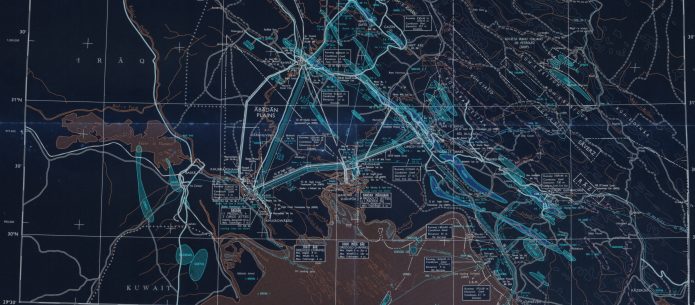
I’ve had a browser tab open since March 2024. It’s the page about Scenes of Extraction (2023) on filmmaker and researcher, Sanaz Sohrabi’s website. I kept it there as a reminder and pledge to write about the film after I watched it at Glasgow Short Film Festival, and it stayed there for two years. The scrawled notes taken in the dark of the CCA cinema become less legible over time, and the memory of the film becomes less detailed. Less detailed, but still insistent: its description of reflection seismography has become the way I enter those current philosophical discussions about elemental media, and its cut-up and reframed archives of the early Iranian oil industry are how I think about visuality and extraction, about operational images, about – as Sohrabi puts it – “the nexus of seeing and destroying”.
This is the last film discussed in Brian Jacobson’s 2025 book, The Cinema of Extractions, and in the book it is presented in dialogue with Araya (Margot Benacerraf, 1959), which was the closing film at Alchemy festival on May 2025. I had to finish this blog post, not just to organise my thoughts but also to show public gratitude to the people who put on festivals and make these encounters with film possible. I’m returning to it now after another curated encounter with Sohrabi’s work via the Centre for Energy Ethics’ online reading group. This time, we got to watch One Image, Two Acts (2024), while also reading a section of Mona Damluji’s new (open acccess!) book, Pipeline Cinema (2025), which places the moving image as part of the “cultural infrastructure” of the oil industry in Iraq and Iran. I’ll come back to Sohrabi’s films in the next post, and to Araya in a third one.
My blogging backlog has the benefit of showing how the theme of ‘extraction’ has continued to proliferate across scholarly collections, calls for papers, and festival programmes over the last few years. It is used to articulate new and old materialisms, to claim a political dimension in ecocriticism, to redirect attention to minoritised media, and to reappraise industrial and sponsored film. You can do lots of things with extraction. At the same time, the growing choice of ‘extraction’ rather than ‘extractivism’ gives me pause. They are different words, of course. As Thea Riofrancos defines them, “Extraction is the act itself, extractivism is the larger system by which natural resources are taken from one place and moved to another with minimal processing”. Much of the theory work that has enabled this analysis comes from Latin American lineages of ideas, what Riofrancos describes as the extractivismo discourse. As some of the concepts have been brought out of political economy and into humanities disciplines, this genealogy tends to recede from view.
An extractivismo framework applied to the analysis of film and other media can take many forms, and in the best examples, it also enacts self-reflection. It can help researchers and filmmakers to consider how their own actions can be extractive, even extractivist (when one considers the global disparities that shape how academic knowledge circulates, how it is valued, and who benefits from it, for instance). It thus needs to be reflexive on its own use of this framework. I’m not saying anything new by pointing out how concepts that emerge from political struggles can get defanged and appropriated by academics; it happens all the time. I also wouldn’t be interested in a purely self-regarding discipline that isn’t in dialogue with all others and with the world. We just have to try and be honest about it, which isn’t easy.
Regardless of what I might write in funding applications, I’m not convinced that analysing films is a meaningful way to bring about a better world or support the people putting their lives on the line for it, which doesn’t mean it’s not worth doing. In his book, which I reviewed for the HJFRT (apologies for the Taylor & Francis paywall, pre-print here), Jacobson makes the case for textual analysis, drawing on literary and art-history concepts. The emergent ‘eco-formalism’ is part of a very long discussion about the politics of form and the political potential of formal critique. In the next two posts I’ll muddle through my own encounters with films about extraction as I try to figure out what I think about this.
Next up:
- Petrocinema and the question of reparations: Can the extractive image break free?
- Silences of labour in Araya (1959) and Morichales (2024): Araya (1959) and Morichales (2024)
Pingback: Can the extractive image break free? | Outwith
Pingback: Araya (1959) and Morichales (2024) | Outwith